Assembling parts into a complete functioning device cannot be done without joining techniques. These include the most common such as screwing and gluing or the more advanced forms such as ultrasonic welding. To give you an impression which techniques we currently have in house, you will find an overview below. This overview changes over time as we expand our methods in line with market demand.
Mechanical connections
By this we mean all methods of attaching parts together. These can be parts from different fields such as metal, plastic, electrical parts and electronic. The techniques we currently use are:
- Clicking: Method of joining parts together using snap connections.
- Screws: The most common head shapes of screws: Phillips head (Phillips, PH), Pozidriv (PZ), Slotted head (Flat head), Torx (T), Hex socket (Hex, hexagonal), Square (Robertson), Hex (Hex outer), Tri-Wing, Star with pin (Security Torx), Tensioner (Snake Eyes). For other type of connections we purchase the tools.
- Ultrasonic welding: The joining of plastic parts through high-frequency vibration which melts connecting seams and forms a strong weld.
- Pressing: The assembly of clamping parts under (high) pressure, such as the fitting of bearings.
- Blind riveting: Better known as riveting.
- Adhesives: Adhesive techniques applied are: seconds adhesives, single component adhesives, silicone adhesives, 2 component adhesives, epoxy adhesives, single sided tapes and double sided tapes. This is according to the application.
- Soldering: This involves soft soldering and brazing.
Electrical connections
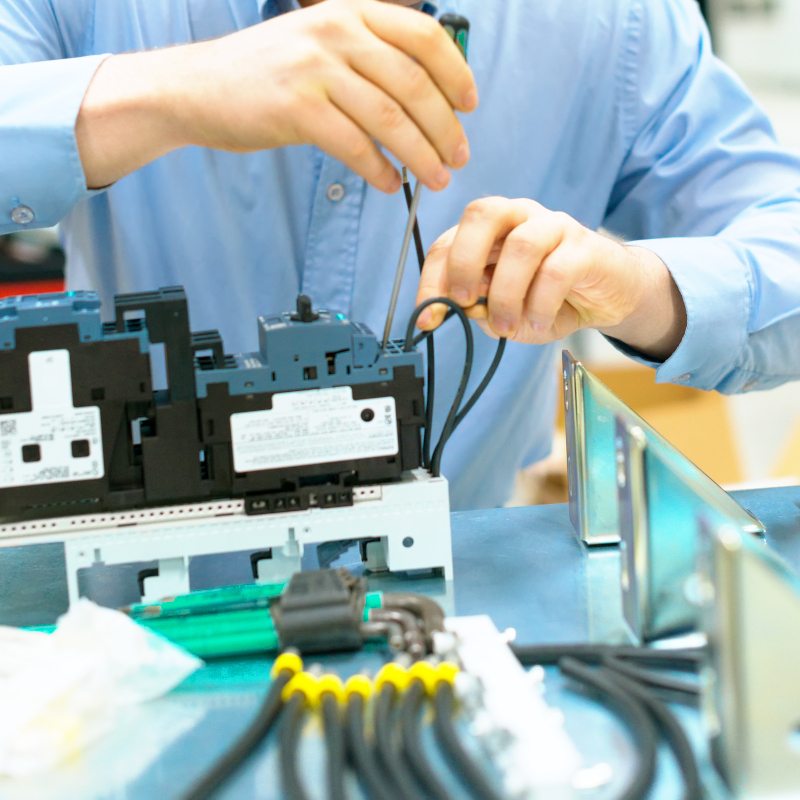
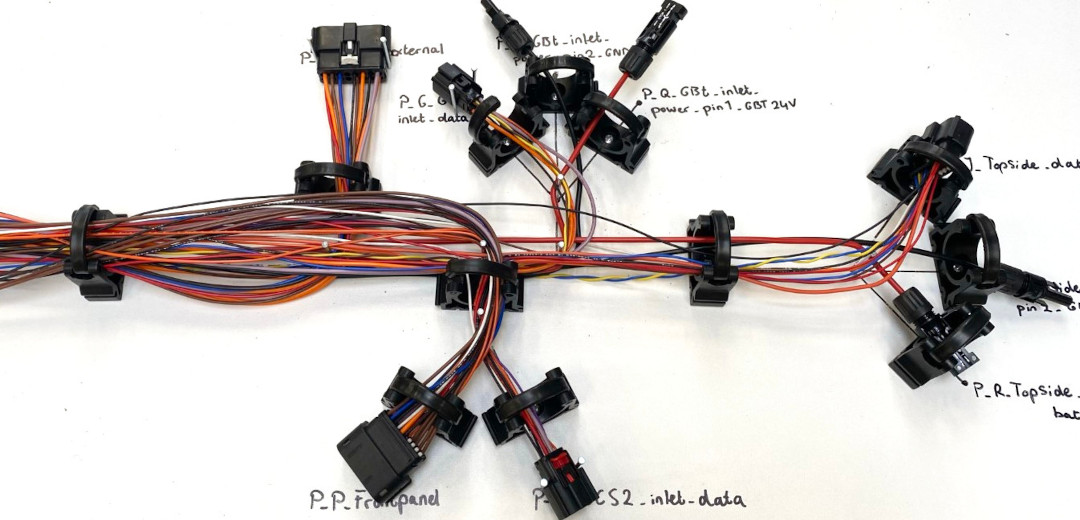
A not insignificant part of mechatronic devices is formed by wiring. This takes the form of single wires, multi-core cables to complex wiring harnesses. The operations involved are:
- Cutting and stripping: Cutting wires to length as well as removing insulation.
- Crimping contacts: Contacts provide the connection between the wire and a part. Crimping or pressing is done with specially designed tools. The variety of different types of contacts we process is very large.
- Soldering: connecting wires and components by soft soldering.
- Installation of components: Consider din-rail, switches, power supplies, PLCs and fuses.
ESD-safe connections of electronic components
Another important category of parts of mechatronic devices are the electronics components. In other words, all parts that contain electronics. These must be processed in an ESD-safe manner to prevent damage to these components. Damage that is not always visible and noticeable but which can have a shortening effect on the life span. ESD stands for Electro Static Discharge For working with sensitive electronic components, we offer ESD-safe solutions, for:
- Installation and soldering of PCBs (printed circuit boards) (Through hole and smd).
- Connecting flatcables and flex printing.
- Integrate optical components such as LED lighting.
- Installation of special components such as sensors and chips.
Customer-specific techniques
In some cases, our techniques are not sufficient. In that case, we introduce the required technique. This may be because our customer provides a technique or we search for the technique on the market. We thus go beyond standard solutions. Do you have specific requirements or techniques you want to implement? We are open to customer prescribed methods and are happy to think along with you.
Contact Us
Wondering how our joining techniques can support your project? Contact our team and discover the possibilities.